
This guide is for gardeners who want something more immersive than a traditional border, but don't know where to begin.
Six years ago I stood in front of a newly prepared garden with thousands of plants to place. But I didn't know what to do next because I wasn't trying to create a traditional border. I wanted something I could walk through.
By the second season, as the plants filled in, I realized something was missing: I needed a way into the garden. I had beautiful swaths of plants, but they still weren't immersive because they were large islands that I had to walk around.
So I kept carving paths and moving plants until the garden had become closer to my vision.
This guide is the product of years of observation, trial and error, and reverse-engineering what worked. I left that garden behind, but not the lessons. I'm here to share those with you.
Most garden design advice starts with plants. The expectation is that if you choose the right plants and place them correctly, the design is complete.
I think garden design needs to start with how you want it to make you feel. When you step into a garden, you react to the overall feeling before you notice the individual plants.
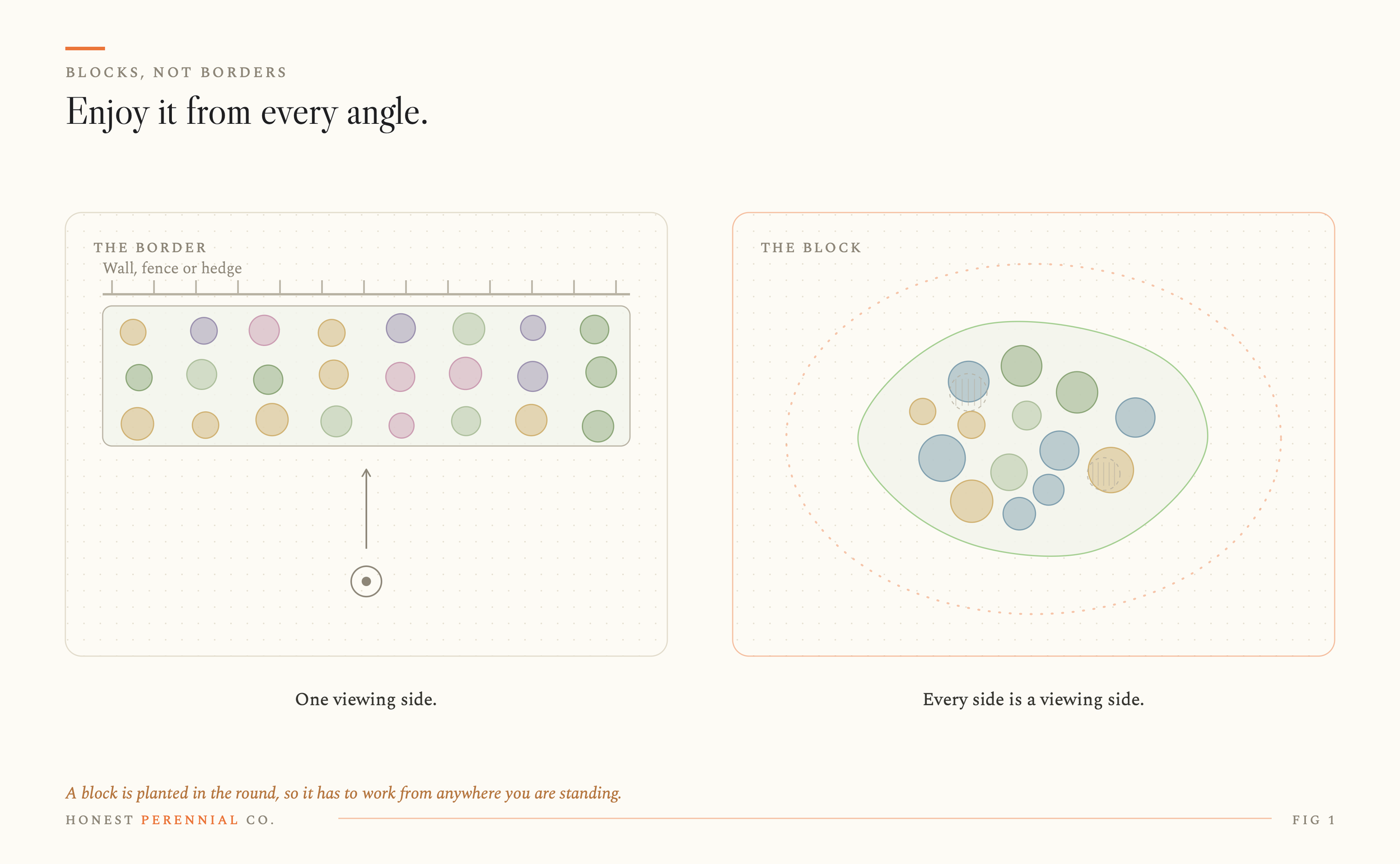
The border model (plants in strips along the edges, open space in the middle) makes the garden the frame. The lawn is the painting. Everything is organised to decorate the edges of a space you look outward from.
The gardens that I remember most surrounded me. I was inside them, not outside looking in, like standing behind a velvet rope in a historic mansion. They're immersive.
My first garden was in a dense part of the city, just a small front lawn and a backyard that was essentially a shaded landslide. I started gardening in the front the way most people do: tearing up sections of lawn, putting in whatever caught my eye. But as I worked, I liked the feeling of being inside the garden rather than standing outside looking in.
So I kept going, planting densely. The space was maybe fifteen by fifteen feet, but the feeling completely changed when I filled it with plants, rather than just framing it with them.
Then I moved my sitting area to the space against the house, where the old shrubs used to be. So not only could I be inside of the garden, but I could also view it from every angle, and sit inside it. That garden planted the ‘immersive’ bug in me that never left.
By bending the frame of traditional advice, a garden can evoke an emotion beyond pride.
Rethinking the Traditional Layout
The conventional front garden puts the lawn between you and the plants. The reimagined version reverses it: the garden fills the space, a path pulls you in, and seating sits against the house, screened by the planting. The feeling is completely different, yet the footprint is identical.
Likewise, the conventional backyard wraps the garden around the fence and puts grass in the middle. You stand on the patio and look at it. The reimagined version moves the garden to the centre, weaves paths around it, and tucks seating into the back corner. Now you're surrounded. The fence disappears.
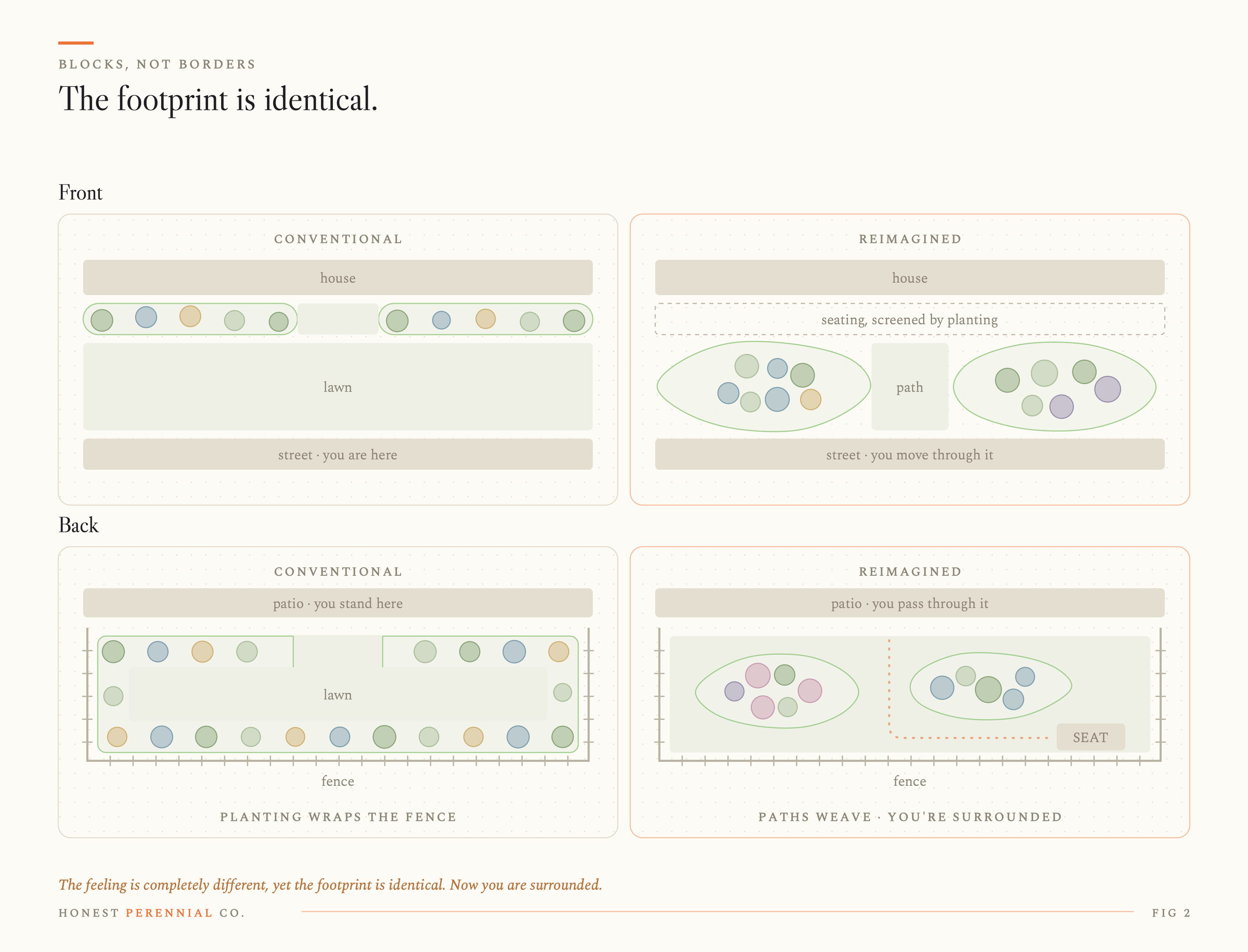
By rethinking the traditional layout, the garden becomes something you experience rather than something you admire.