
It can be overwhelming to design a large space as a whole. I needed a way to break it down.
It came together when my husband built me a series of raised beds in different dimensions.
I could fill them, stand in them and experience each one as a whole, away from the pressure of the larger garden.
I landed on roughly thirty square feet as the workable unit: 3×10, 4×7 or 5×6, round or square. For those of us who aren't great at spatial awareness, think of a suburban walk-in closet. It's small enough to take in at once, and large enough for plants to tell a story.
The block itself is purely conceptual, a design tool to build in manageable pieces. Once you remove the imaginary boundary, it should simply read as garden.
Your finished Blocks should never look like Blocks. As the plants grow together, the divisions disappear.
How to Design With Blocks
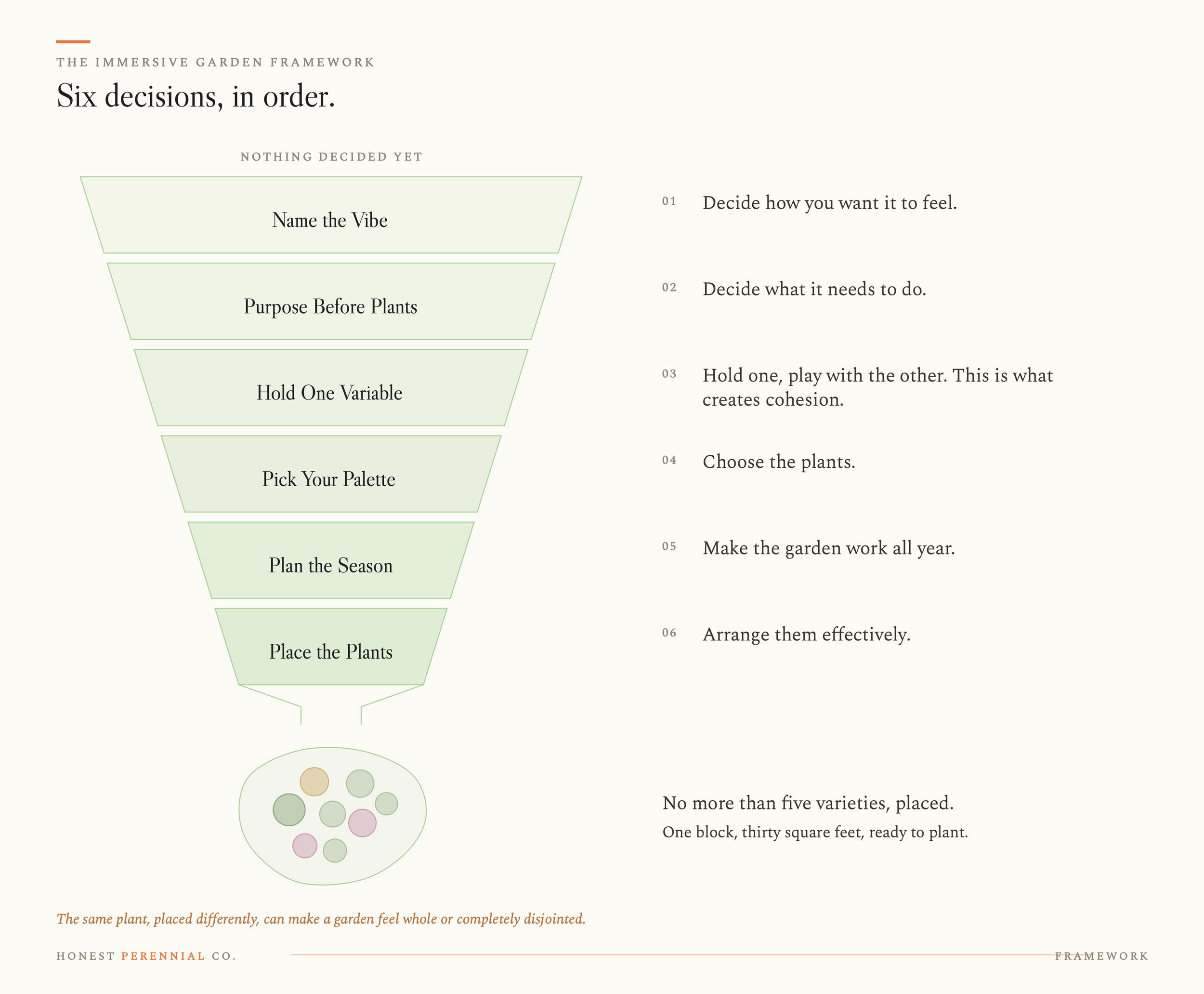
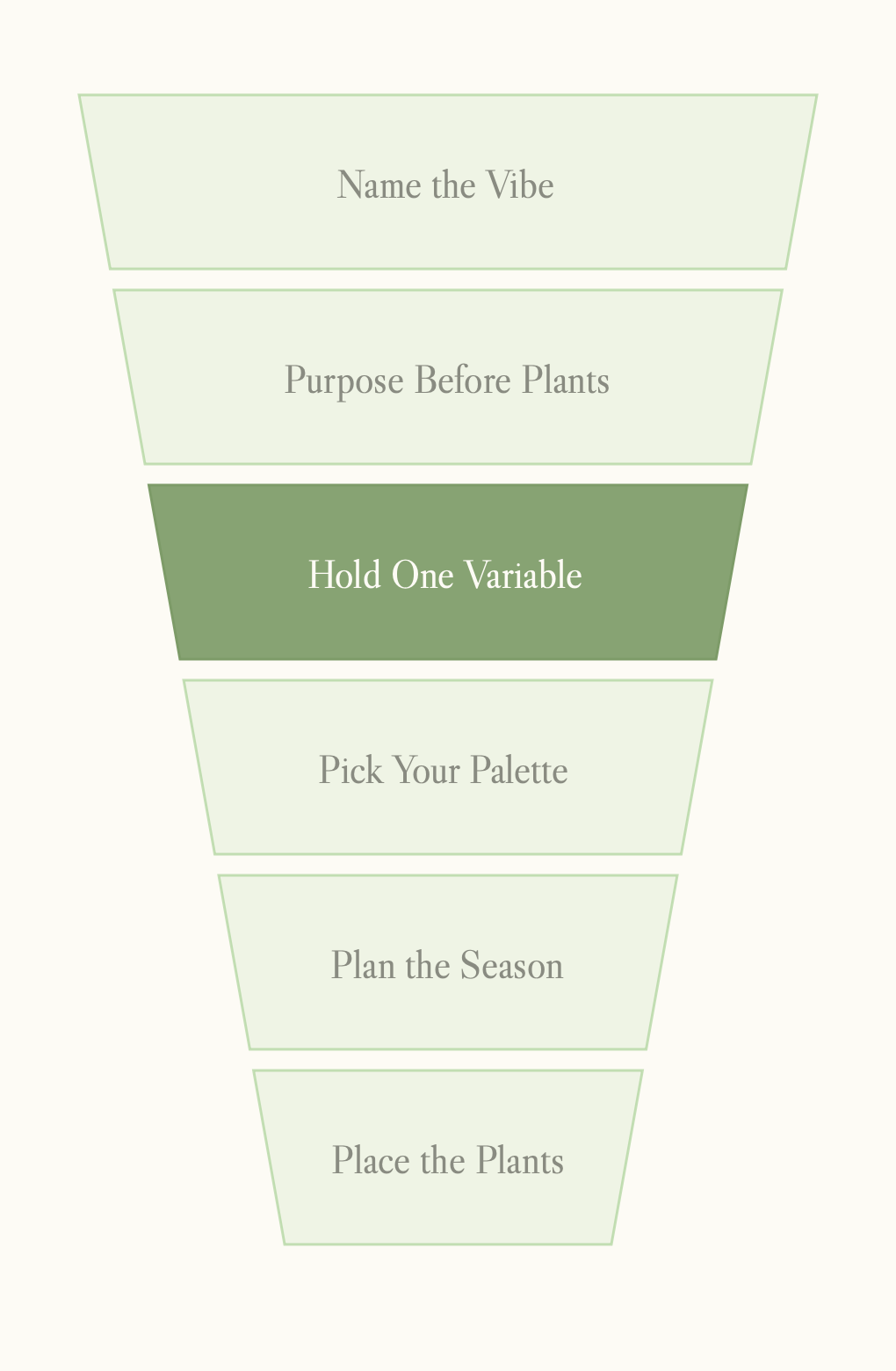
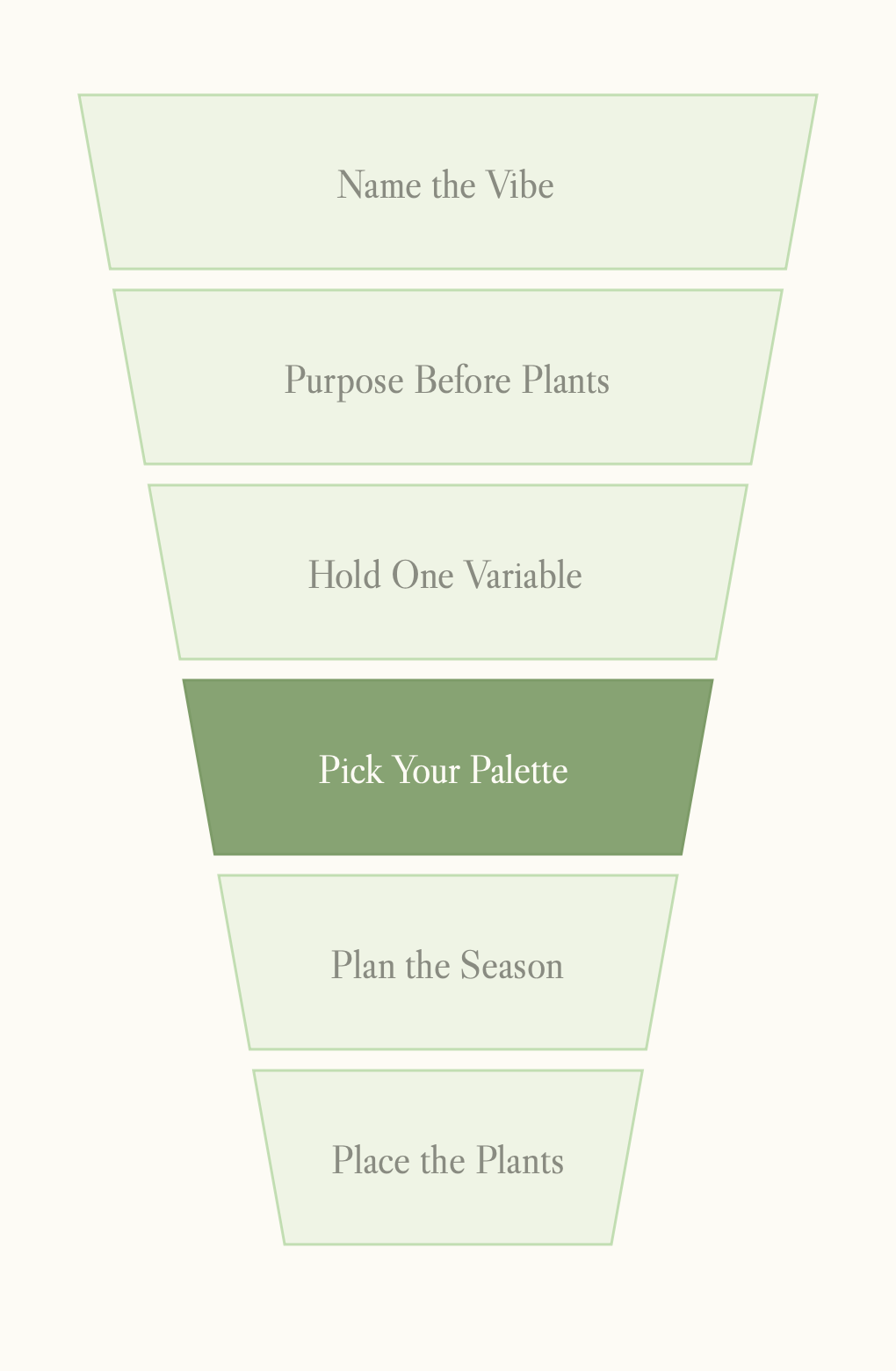
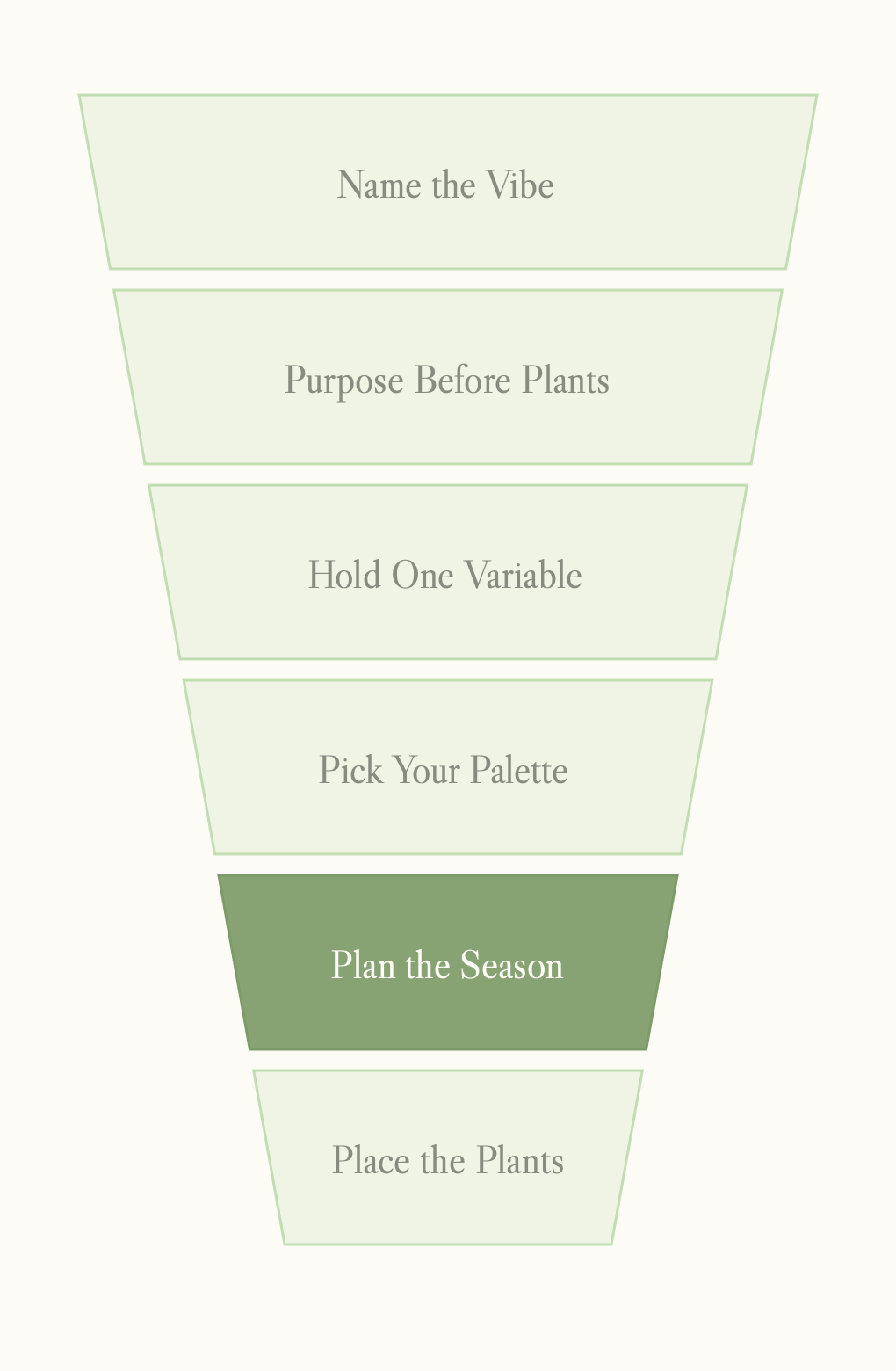
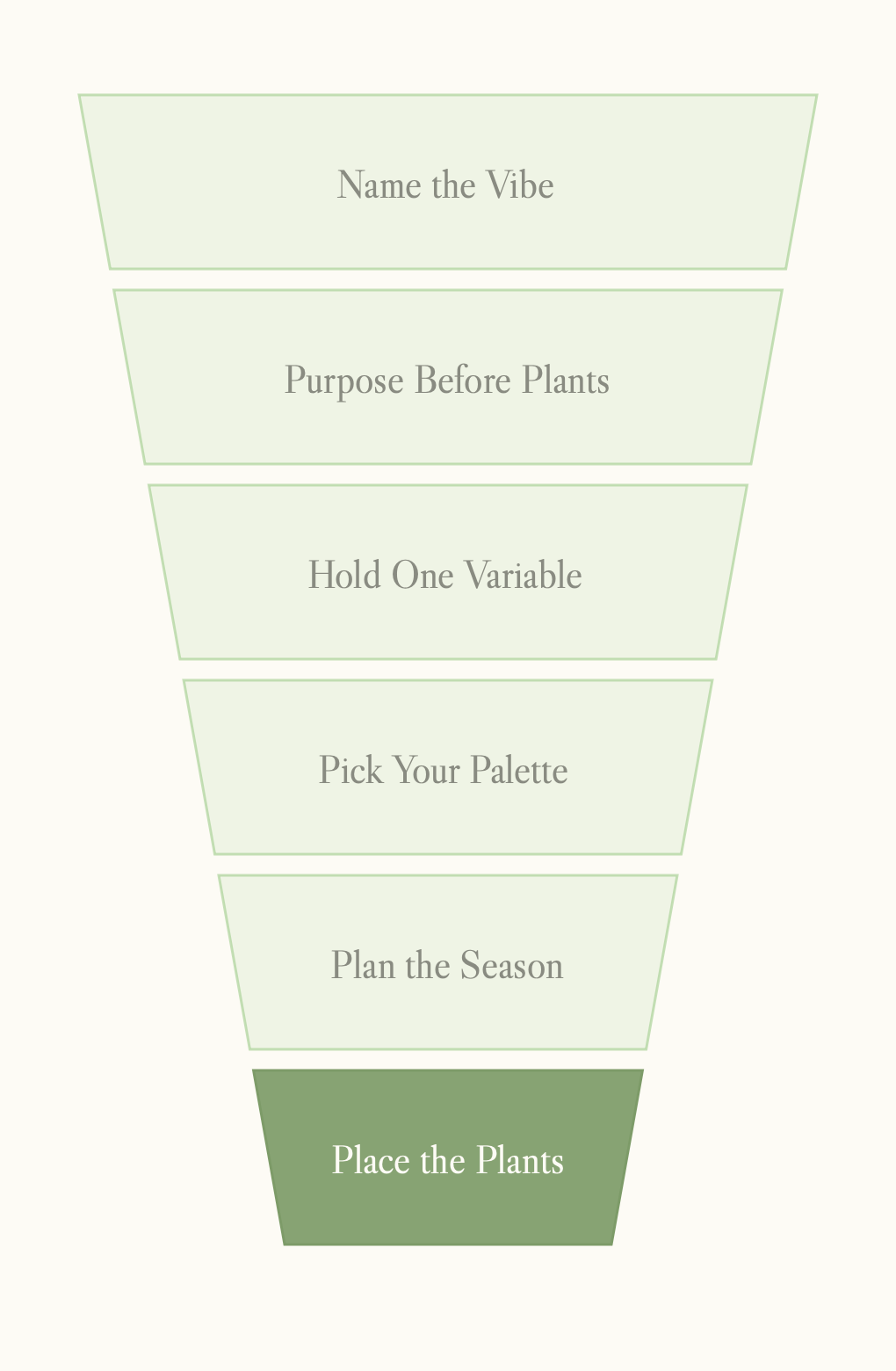
I design every block the same way, like a funnel, with my final plant choices coming out the bottom.
Step 1 | Name the Vibe How should it feel?
Step 2 | Purpose Before Plants Does the garden have a practical function?
Step 3 | Hold One Variable There are three: height, colour, and number of varieties.
Step 4 | Pick Your Palette The right balance of Workhorses, Staples and Divas for this spot.
Step 5 | Plan the Season By now most of the work is done, the field is already narrowed.
Step 6 | Place the Plants How each plant is used, based on its natural character.
Step 1 | Name the Vibe
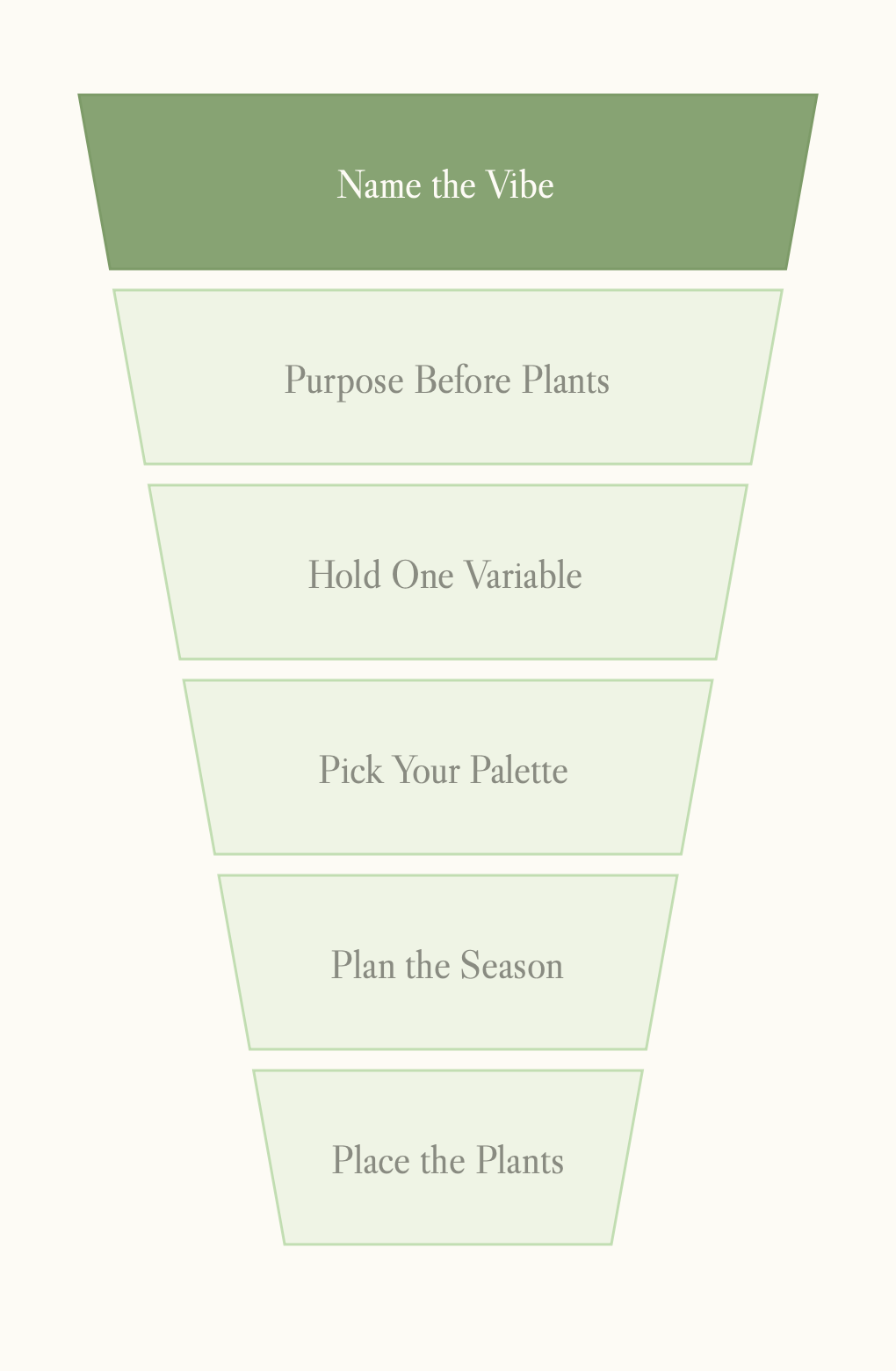
Most gardens fail because the plants got chosen before the feeling did. Vibe is how you want the Block to feel. Decide that first, then choose plants that support it.
Depending on the size of your canvas, you can create completely different vibes across your space. You're not making this decision once; you make it block by block, or zone by zone.
Sometimes the vibe arrives on its own. My first planting was almost an accident; Coneflower 'White Swan' and Deschampsia grass in a windy spot. Other times it's practical: I once wanted to restrict sight lines but still see customers walking up. That shaped how I thought about the design.
Whether emotional or practical, be explicit about vibe for each space. The blocks I didn't think about this way, the ones I planted because the layout looked correct on paper, ended up intellectually right and emotionally flat. I ripped most of them out and started over.
I can't tell you what will make you feel something. A formal edged garden does nothing for me, it takes away the illusion of nature. But some people love a clean edge; they feel calm looking at it. That's their vibe, not mine, and that's the point.
Vibe is why two gardeners can look at the same plant and disagree completely. Globe thistle is sculptural to one person and a weed to another.
Vibe is personal. This section isn't here to hand you one, it's here to help you recognize yours.
Bold or Quiet?
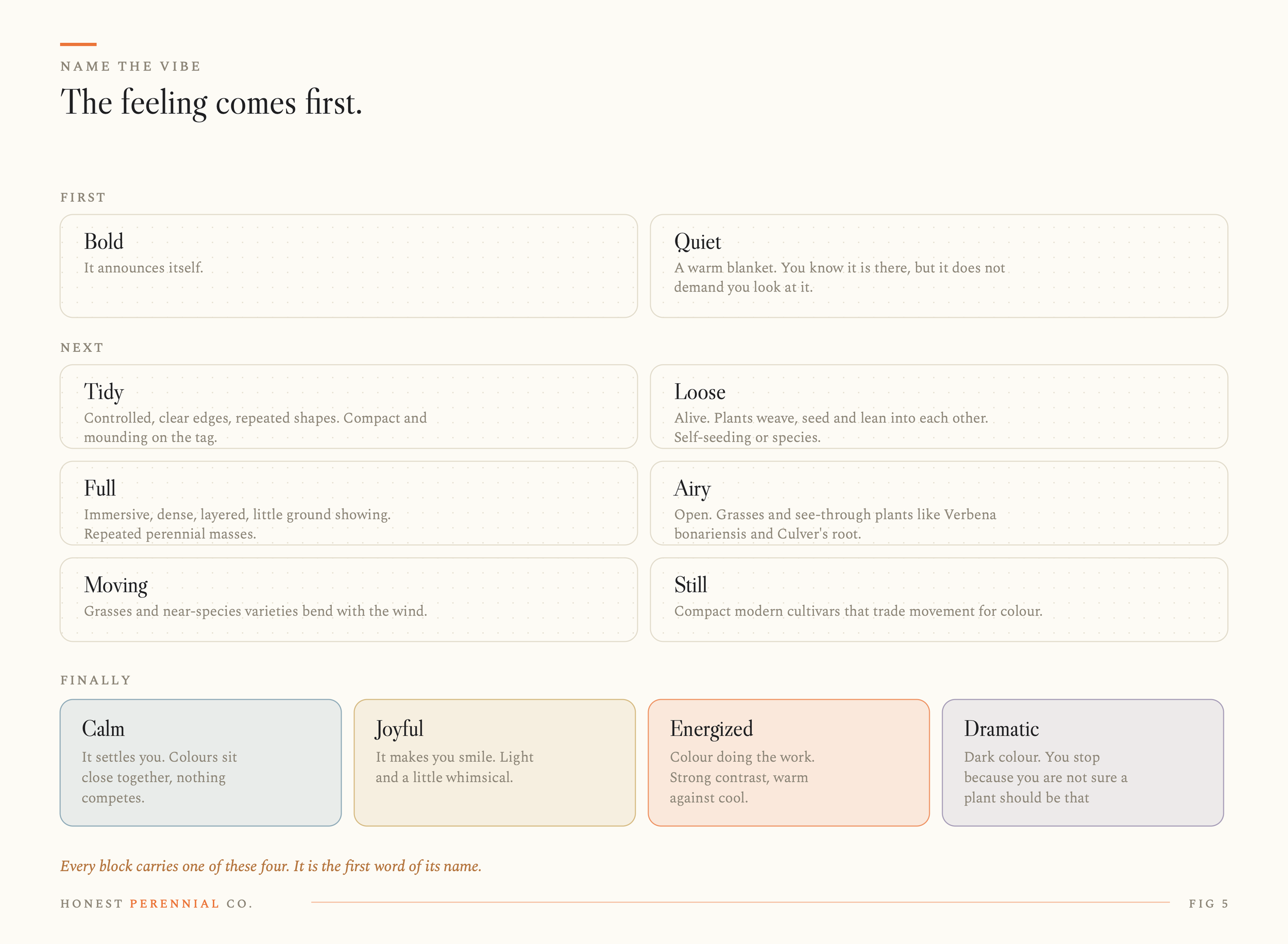
One choice dictates different plants, colours, and movement. A bold garden announces itself. A quiet garden is a warm blanket, you know it's there, but it doesn't demand you look at it.
If you want bold Bee Balm 'Panorama Red' · Delphinium 'Pacific Giant Mix' · Hollyhock 'Las Vegas' · Coneflower 'Cheyenne Spirit'
If you want quiet Catmint 'Walker's Low' · Great Burnet (Sanguisorba) · Culver's Root · Coneflower 'White Swan'
Even if you want overall bold, pockets of quiet are appreciated, like light and shade. Giving the energy a break makes it feel more dramatic when you hit it.
Tidy or Loose?
Tidy or loose Tidy feels controlled, clear edges, repeated shapes. Loose feels alive, plants weave, seed, and lean into each other. The tag gives clues: compact and mounding means tidy; self-seeding or species means loose.
Full or airy Full feels immersive, dense, layered, little ground showing, leaning on repeated perennial masses. Airy feels open, leaning on grasses and see-through plants like Verbena bonariensis and Culver's root.
Moving or still Grasses and near-species varieties move and bend with the wind. A still garden comes from compact modern cultivars that trade movement for colour.
In a Word…
Everything above narrows to one word. Colour often carries the most weight, but form, density and movement help create the feeling too. Name the feeling and the block has identity in a single word.
Calm It settles you. Colours sit close together, nothing competes · Catmint 'Walker's Low', Salvia 'Swan Lake', Deschampsia 'Goldtau'
Joyful It makes you smile. The happy plants, light and a little whimsical · Allium 'Globemaster', Shasta Daisy, Coneflower 'Cheyenne Spirit'
Energized Colour doing the work. Strong contrast, warm against cool · Salvia 'Caradonna' with Coneflower 'Red Ombre', Yarrow 'Moonshine'
Dramatic Dark colour. You stop because you are not sure a plant should be that colour · Hollyhock 'Arabian Nights', Bee Balm 'Panorama Red', Big Bluestem ‘Blackhawks’
Step 2 | Purpose Before Plants
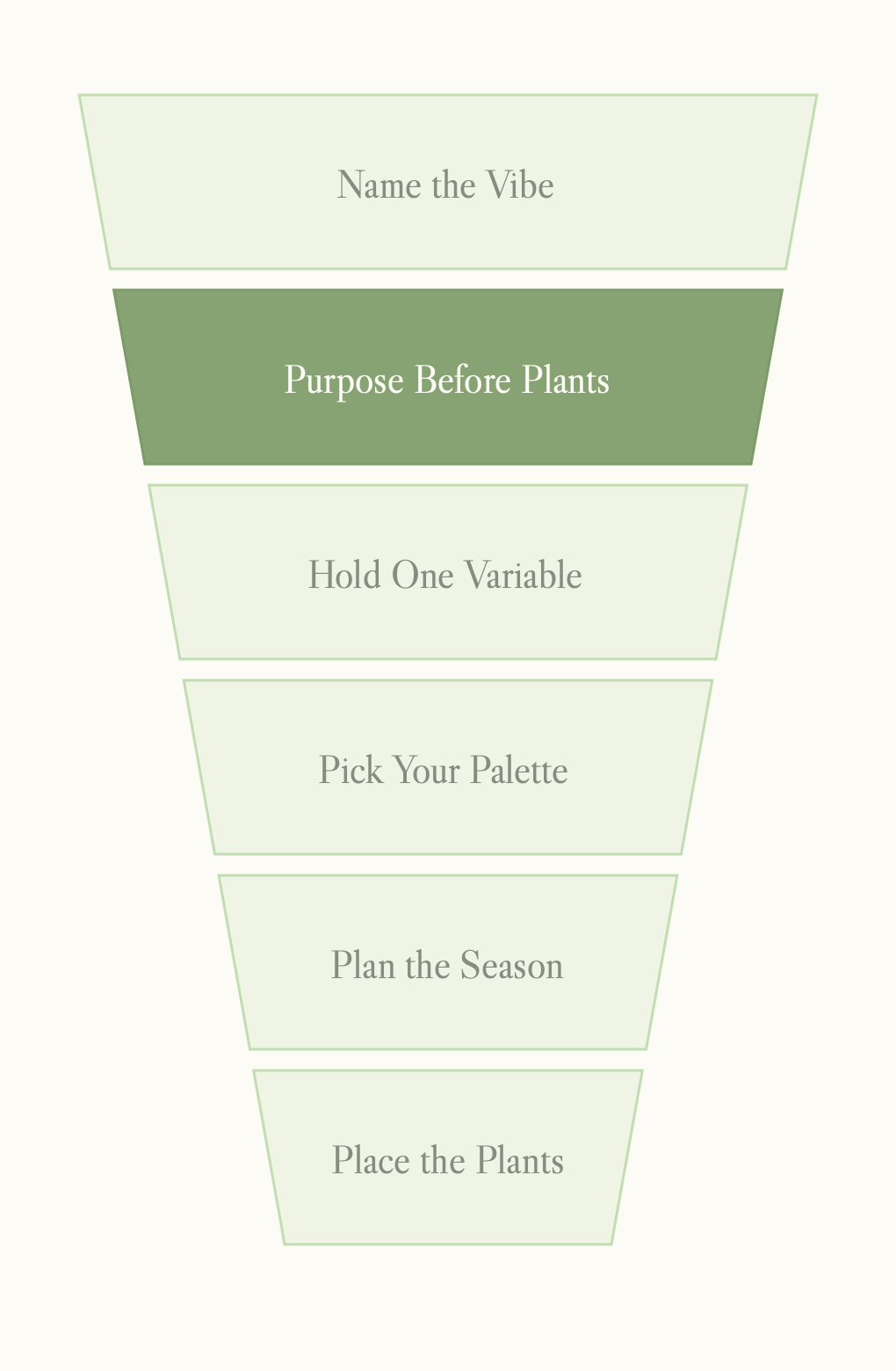
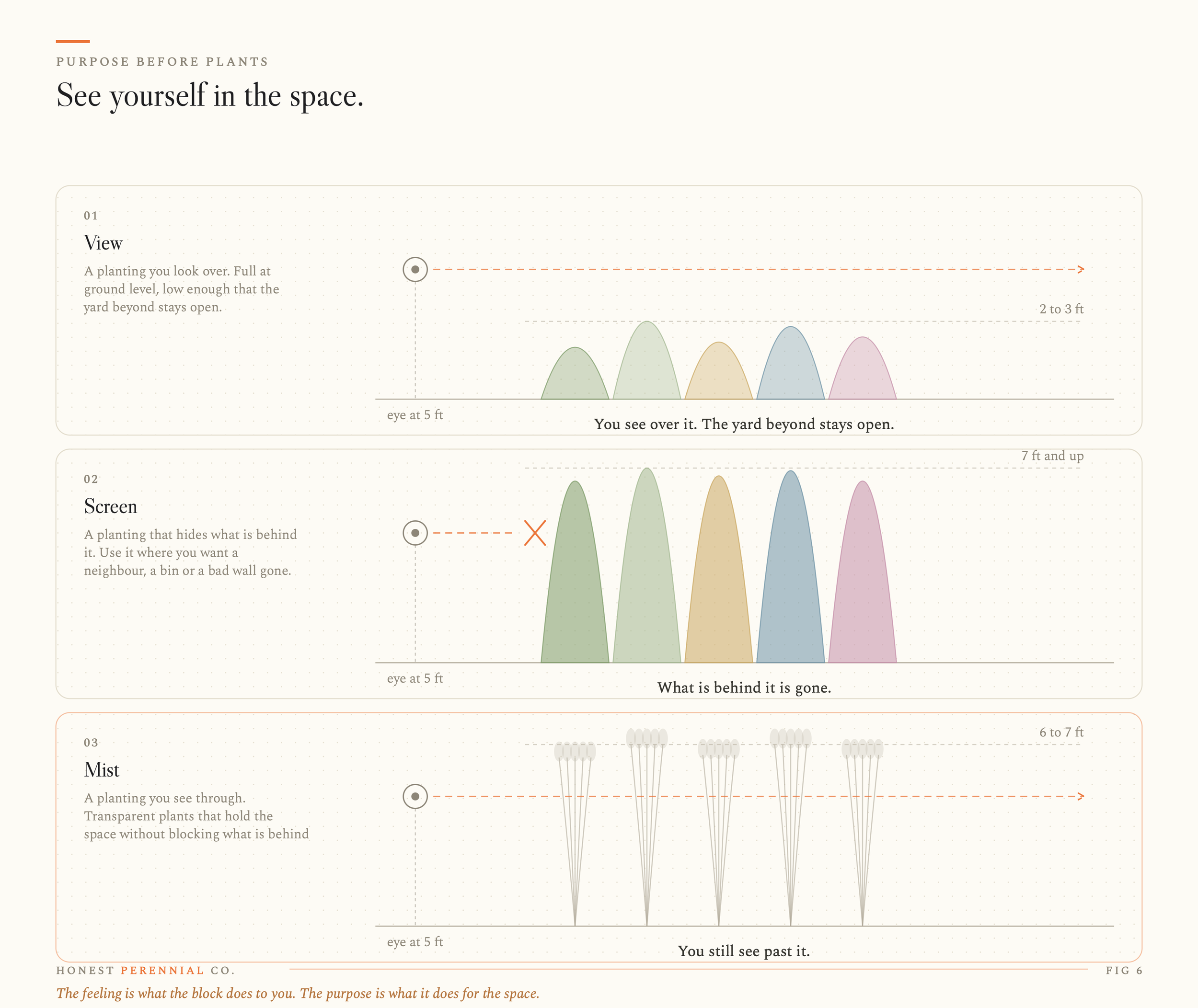
The feeling is how the block impacts you. The purpose is what it does for the space. Purpose answers the practical question: what does this Block need to do?
View A planting you look over. Full at ground level, low enough that the yard beyond stays open. Use it where you want a garden and a view.
Screen A planting that hides what is behind it. Use it where you want a neighbour, bin or unattractive wall screened.
Mist A planting you see through. Transparent plants that hold the space without blocking what is behind them.
Feeling first, purpose second. Together they name the block: an Energized View, a Calm Mist.
Step 3 | Hold One Variable
The variables you're working with are colour, height, and number of varieties. I hold firm on no more than five varieties in a block, which leaves me to play with height and colour.
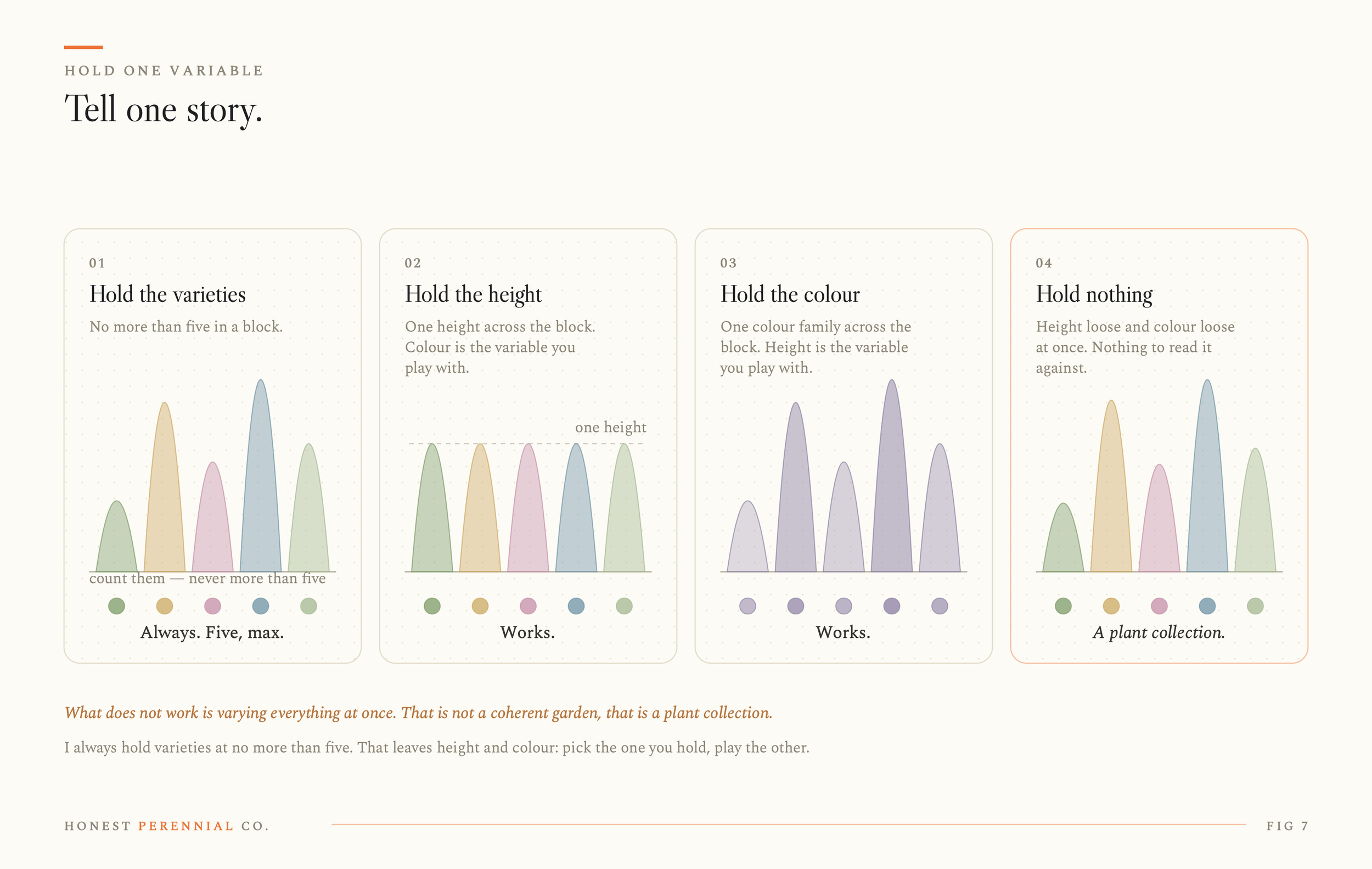
A Block with mixed heights can work beautifully if the colour palette is consistent. A Block that moves across a colour range can work if the heights are similar. What rarely works is varying everything at once. That is more a plant collection, than a coherent Block.
I hold firm at no more than five varieties in thirty square feet. That gives each plant enough repetition to make a statement and keeps the Block from becoming visually scattered.
Step 4 | Pick Your Palette
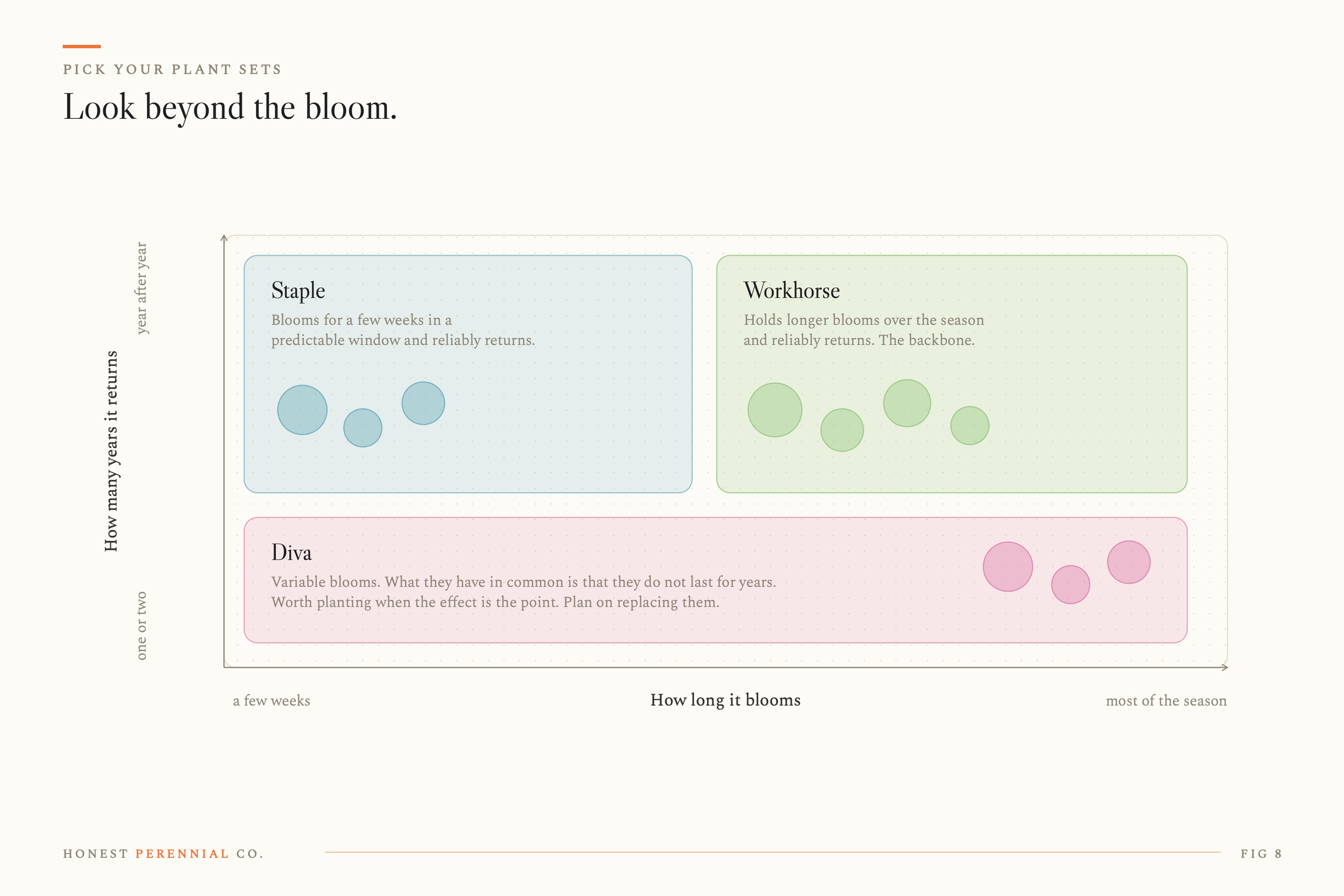
Plant Sets help you build a palette by showing how plants behave over time, how long they contribute and how reliably they return. There are three Plant Sets.
Workhorses The backbone. They bloom for a long stretch and return reliably, building your garden over time. What most of us mean by "perennial." They make sure the garden holds together.
Staples A shorter bloom window. Over a season they come and go. Think: Lupines in late spring, columbines in early summer, liatris in midsummer.
Divas They are closer to decor, heavily bred and sometimes have little ecological value, but they can look incredible. They may bloom for months, but they fade over time.
Getting the Mix Right
As with a great dish, getting the mix of ingredients right, matters as much as picking good ones.
There is no right mix, but it's worth understanding the implications. So many customers were disappointed when their garden disappeared, not realizing they'd planted a garden full of Divas. They were never meant to last.
The Trade-offs
Heavy on Staples: more seasonal variation, but bloom windows must be staggered carefully.
Heavy on Divas: a dramatic display, but less reliability over time.
Balanced: some of everything, with moderate timing and replacement demands.
Heavy on Workhorses: fewer dramatic peaks, but a more reliable and predictable Block.
Step 5 | Plan the Season
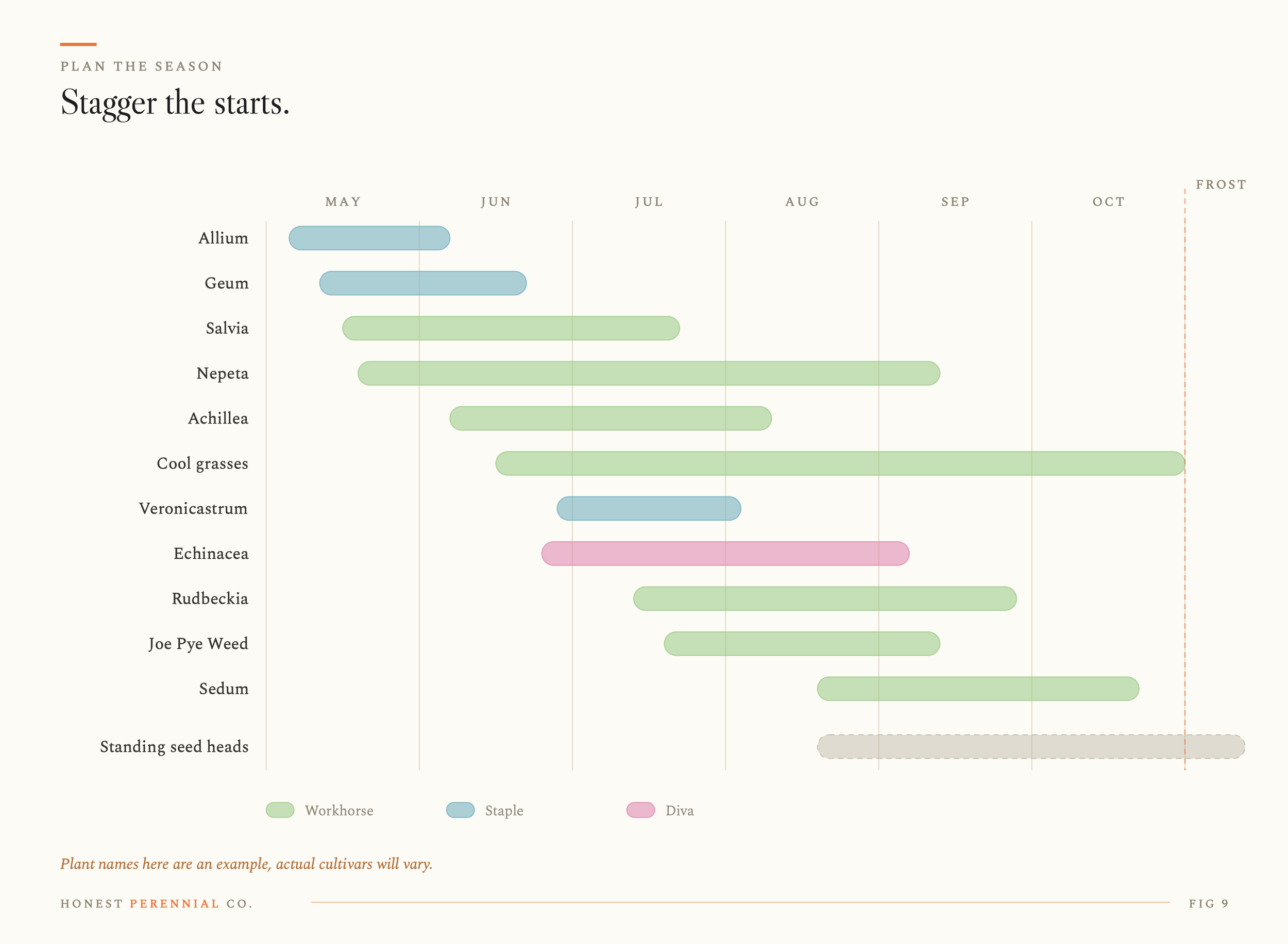
Once you have a plant palette, lay it across the season. The goal is not to have everything bloom at once, but to keep the Block present as one plant hands the garden to the next.
Look beyond flowers. Emerging foliage, buds, bloom, structure, seed heads and fall colour all contribute. A plant with a short flowering window may still earn its place if it brings anticipation before bloom or structure afterwards.
Check for clusters and gaps. If every plant peaks in July, the Block may be spectacular for a few weeks and quiet for the rest of the year. Stagger the starts so the planting continues to change without disappearing.
Step 6 | Place the Plants
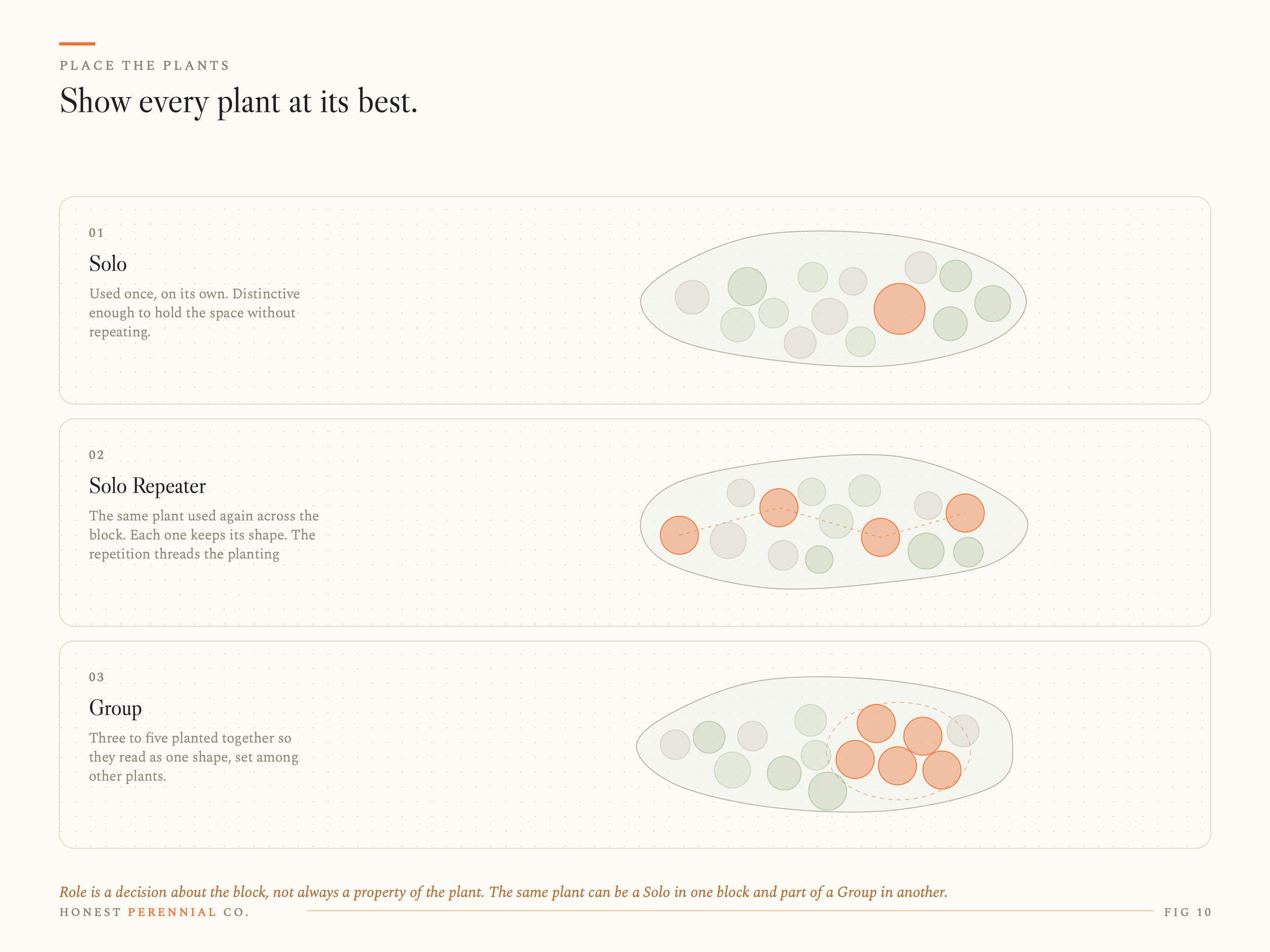
Some plants stand alone; some play best with others. Placement is based on the natural character of each plant.
Solos Used once as a focal point. It has enough size, form or colour to hold its place alone.
Solo Repeaters Used several times across a Block. Each plant keeps its individual shape, while repetition creates rhythm.
Groups Three to five planted together so they read as one shape among the other plants.
Your garden, your rules. These guidelines are based on my experience with these plants and the aesthetic that works for me.
When a Block Fails
A block fails when you walk past it repeatedly and something nags. The space just doesn't hold together, or pull you in.
Too much variety More than five varieties in thirty square feet can be too much for the eye. Nothing repeats enough to create flow.
Mismatched height A few solid plants rise above the rest without functioning as intentional see-through verticals. The block stops reading as unified.
Wrong placement A plant that wants grouping scattered as a repeater. Foxgloves and delphiniums generally read more clearly in Groups than as scattered Solo Repeaters.