

The Immersive Garden Guide
Chapter Three |
The Immersive Garden Framework
PATHWAYS & PAUSES
In an immersive garden there is no lawn to serve as a vantage point. That shift to designing paths and plantings was one of the bigger mental leaps I had to make beyond traditional advice.
It's also where I learned my most expensive lesson. I created plantings up to twenty by twenty feet and lost sight of what was in the centre. I carved out paths after the fact. It was transformative, but completely avoidable.
So decide how you'll navigate before you decide what you're planting, and plan those openings often. I once had a garden running forty feet alongside a path with no break. People cut across it constantly, including me. If you can see the crosswalk, you'll take it. Otherwise you're jaywalking.
Decide Where You Want to Pause
Before you think about paths, find the places where you want to take the garden in.
Where would you sit if you could put a chair anywhere? I would literally drag a chair around as I laid out new areas.
Don't just walk the space; sit in it. These are your pause spaces. They don't need to be large. Once you know where they are, you know where the paths need to go.
Two Types of Paths
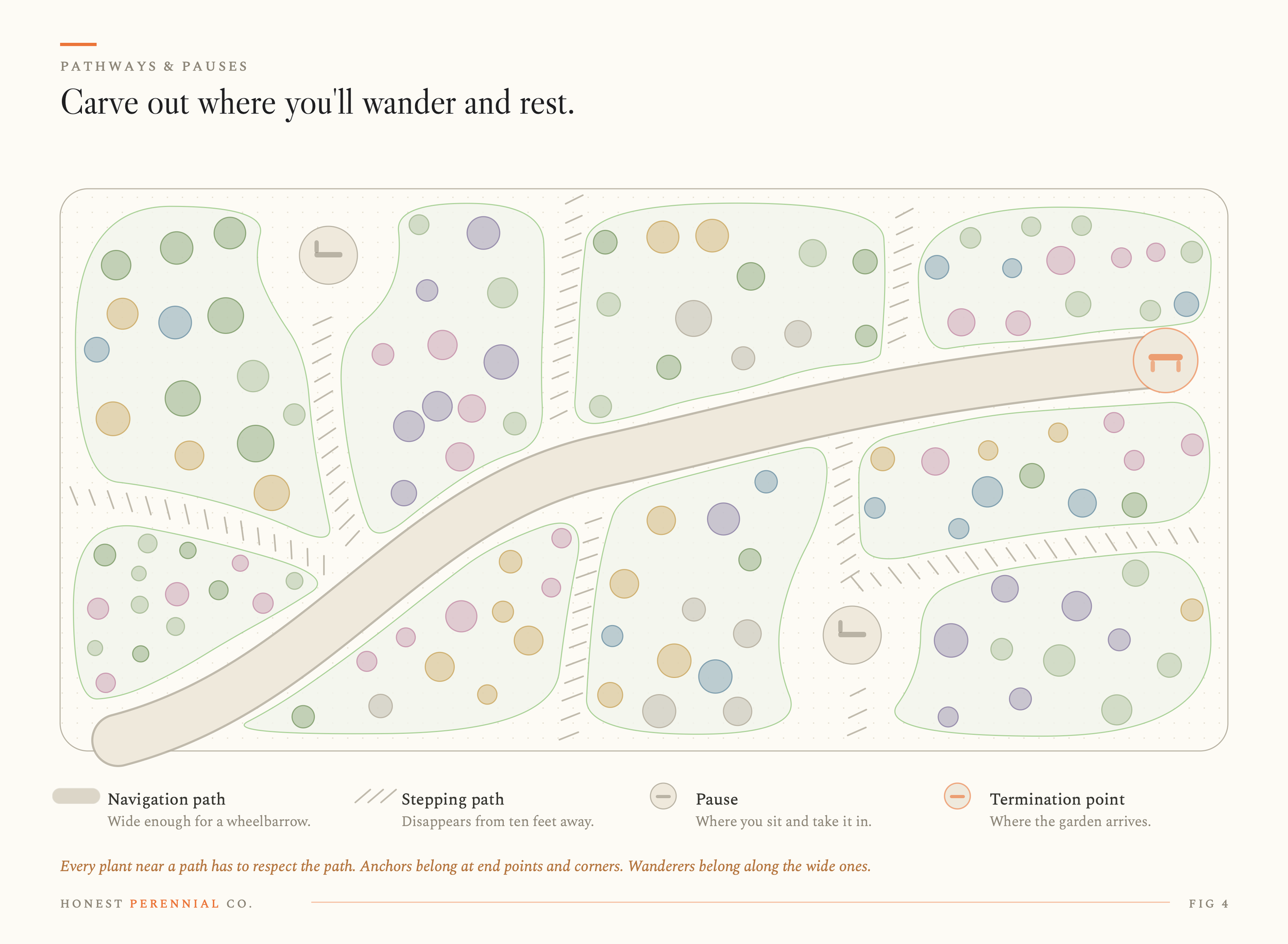
There are two kinds of paths, and they do different jobs. Every plant near a path has to respect the path.
Stepping paths are narrow and informal, made from mulch or large stepping stones. They let you get close to the plants but disappear from ten feet away, so from a distance you see the planting, not the path
Navigation paths move you through the space efficiently. They're wider, connect one part of the canvas to another, and can accommodate a wheelbarrow
I planted globe thistle generously, including along stepping paths. It hurt. Literally. Bee balm swallowed a long entrance path by midsummer. Both have a place in an immersive garden. Just not flanking a path.
Identify Your Termination Points
The garden can't be endless, so there will be natural termination points. Plan them, just as you plan the parts you'll be in. If you plan your plantings on the way to specific end points, they become part of the story, not just the result of the garden ending.
A termination point might open into a dining area or an open yard, or it might be marked by a group of focal plants like hollyhocks. I had one in a row of beautiful maples that cut across our space. When an ice storm took them out, that area no longer made sense as a destination. It forced me to rethink and reconfigure. A termination point doesn't have to be large. It can simply be a small bench.
Next: Design Blocks
Return to: Contents